

TQ vs. EQ: Why Emotional Intelligence Predicts Leadership Effectiveness More Than Technical Expertise
By Joe Folkman of Zenger Folkman, Inc.
Mike’ Note:
I was trained by Zenger Miller in the 1990’s and learned so much about the skills and attitudes of leadership and teamwork. Jack Zenger joined with Joe Folkman to continue their lifelong passion to grow leaders. This blog by Joe reminds us of the importance to re calibrate your leadership as you move up the corporate ladder. It also provides solid research on the value of Emotional Intelligence as a powerful indicator of successful leaders. Read Joe’s insights:
In many organizations—especially highly technical ones—there’s an unspoken assumption: technical expertise is the safest path to leadership success. The logic is understandable. Technical competence is tangible. It produces measurable outcomes. It solves urgent problems. It fails because leaders don’t know how to build commitment, resolve conflict, create clarity, earn trust, or inspire others to perform at their best.
This blog examines a question that many organizations wrestle with (often implicitly): When technical excellence and emotional intelligence diverge, which one matters more for leadership effectiveness?
Using multi-rater 360-degree feedback data (an average of 13 raters per leader), Joe compared leaders with high Technical Quotient (TQ) but low Emotional Intelligence (EQ) against those with high EQ but low TQ. His results reveal a consistent and significant pattern:
Emotional intelligence predicts broader leadership effectiveness
far beyond interpersonal skills alone.
What Do We Mean by TQ and EQ?
TQ (Technical Quotient) refers to a leader’s technical expertise—depth of knowledge, judgment, and credibility in a professional domain. We measured TQ using an index of six items, including a leader’s in-depth knowledge, whether others seek their opinion, and the extent to which their judgment is trusted.
EQ (Emotional Quotient) refers to emotional intelligence—how effectively leaders understand others, manage relationships, handle conflict, and create trust. We measured EQ using an index of seven items, including concern for others, inclusiveness, cooperation, trust, and conflict resolution.
Both TQ and EQ ratings were based on 360-degree evaluations from leaders’ managers, peers, direct reports, and others (averaging 13 raters per leader).
Technical Expertise Matters—But Its Relative Importance Shifts Over Time
Technical expertise is undeniably valuable. In our research, technical or professional expertise ranks as the 7th most important competency (out of 19) for individual contributors but falls to 13th for top-level executives. In other words: technical expertise plays a critical role early in careers and in specialized roles—but becomes less differentiating as leaders rise.
That does not mean leaders can ignore technical competence. A weak understanding of the technical work can undermine credibility at any level. But the data suggests that technical skill becomes the entry ticket—not the differentiator—especially in senior leadership roles.
Why Many Organizations Still Prioritize TQ Over EQ
Despite the leadership data, many organizations default toward technical capability when selecting or promoting leaders. There are several reasons:
Technical output is visible and measurable (bugs fixed, systems improved, products built).
Technically competent leaders can create an immediate impact, especially during crises.
Many organizations carry a cultural bias toward analytical competence as “real intelligence.”
Under pressure, short-term urgency overrides long-term leadership capability.
Hiring a technically strong person with weak interpersonal skills often feels like a “safer bet” than the reverse.
This bias is understandable. But it raises an important leadership question: Does technical expertise actually produce better leadership outcomes than emotional intelligence?
What the Data Shows: Comparing High-TQ/Low-EQ Leaders vs. High-EQ/Low-TQ Leaders
To understand the real impact of TQ versus EQ, we identified leaders who scored at opposite extremes:
High TQ / Low EQ: 241 leaders
High EQ / Low TQ: 706 leaders
This created a clear comparison group: leaders who strongly demonstrated one capability cluster while scoring low on the other. We then examined two high-level outcomes:
Overall leadership effectiveness
Direct reports’ engagement
To make results easy to interpret, scores were converted to percentiles (where the 50th percentile represents the average). The differences between the groups were highly statistically significant on both measures.
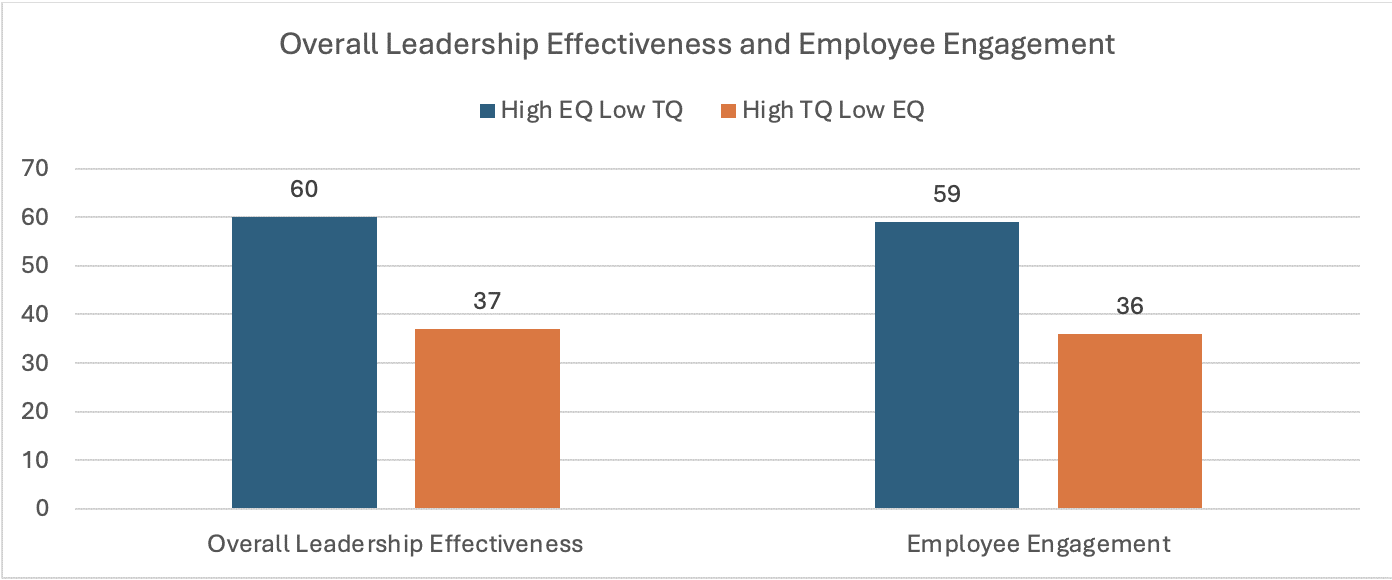
To ensure this wasn’t simply an artifact of non-technical industries, we repeated the analysis focusing only on organizations that were more technically oriented (computer hardware/software, engineering, and manufacturing). The pattern remained significant, with only minor shifts in mean values.
The evidence already challenges a common assumption: Leaders who are high in EQ but lower in technical expertise are rated as more effective and create higher engagement than leaders with the opposite profile.
But the most compelling insight comes from the deeper competency analysis.
The Most Surprising Finding: EQ Influences “Hard” Leadership Outcomes
We analyzed differences across 19 differentiating leadership competencies.
Leaders high in TQ but low in EQ were rated significantly higher in only three areas:
Technical or professional expertise
Problem-solving and analysis
Decision making
The two groups were rated about the same on three competencies (integrity/honesty, taking risks, and driving for results).
But leaders high in EQ and low in TQ were rated significantly higher in 13 of the 19 competencies—including:
Relationship and leadership essentials
Builds relationships
Communicates powerfully
Develops others
Inspires and motivates others
Collaboration and teamwork
Values diversity
Execution + enterprise leadership capabilities
Takes initiative
Champions change
Customer/external focus
Establishes stretch goals
Develops strategic perspective
Innovates
Learning agility
This is the key point:
Emotional intelligence doesn’t just improve interpersonal skills. It strengthens leadership effectiveness across the broader enterprise, meeting the demands of the role in strategy, change, innovation, initiative, and learning.
What This Means: The Technical Skills Trap
Technical expertise often feels safer. It is easier to measure, validate, and reward. But the data reveals a consistent reality:
Leaders who excel technically but lack emotional intelligence are significantly less effective overall.
They may solve immediate problems, but they struggle to:
generate commitment rather than compliance
build trust across stakeholders
develop talent and capability
drive change
create conditions where innovation thrives
In contrast, leaders who are high in emotional intelligence outperform in nearly every dimension of leadership effectiveness—including those often perceived as “hard” leadership outcomes.
Beyond the False Choice
The takeaway is not that EQ replaces TQ—the takeaway is that treating them as competing priorities creates a false tradeoff.
TQ is essential early in careers and in specialized roles.
EQ becomes the multiplier as leaders rise.
As leaders take on broader accountability, their success depends less on what they personally know—and more on what they can enable others to do.
The Strategic Imperative for Organizations
Organizations that prioritize technical excellence while under-investing in emotional intelligence are optimizing for short-term problem-solving at the expense of long-term performance. In a world where AI increasingly expands and commoditizes technical capability, the differentiator will not be technical knowledge alone. It will be the ability to build trust, create clarity, navigate conflict, lead change, and inspire human performance.
The question is not whether your leaders are technically competent. It is whether they have the Emotional Intelligence needed to unlock the full value of their expertise—and the potential of the people around them.
Thanks, Joe for these research-based insights. This blog first appeared on Joe’s LinkedIn page.
Mike’s Wrap-up: If you wish to explore how your organization may develop the Emotional Intelligence of your managers and leaders, call me for a no-obligation chat.
Michael J Griffin
Founder and CEO of ELAvate
A Former Disciple of Zenger Miller
EQ Trainer for Leaders and Teams
michael.griffin@elavateglobal.com
+65-91194008 (WhatsApp)