

5 Reasons Why Emotional Intelligence Matters in Sales

Emotional intelligence could make the difference when trying to close a deal.
By Jennifer Dublino
Successful salespeople possess many skills. They exude confidence in sales pitches, are motivated to seek out and drive new business, and develop the knowledge to educate prospects about their company’s products and services. But the most valuable skill of all may be their emotional intelligence, also known as EQ.
Closing high-level sales involves emotionally connecting with customers. Creating genuine connections means understanding and harnessing your own emotions as well as your prospects’ and customers’ emotions. These skills embody emotional intelligence. We’ll explain more about emotional intelligence, why it matters in sales, and how to cultivate it in yourself or your sales team.
FYI
Emotional intelligence may predict your success as a business owner. Emotionally intelligent business owners understand their employees, customers and partners, fostering success in multiple areas.
What is emotional intelligence?
Emotional intelligence is the capacity to express and control one’s emotions, read others’ emotions and respond empathetically. Emotional intelligence has five components:
Self-awareness
Self-regulation
Social skills
Empathy
Motivation
“The key benefit of emotional intelligence is empathy. You develop empathy for your customers by communicating, caring and understanding,” said Anthony Miyazaki, professor of marketing at Florida International University. “You use open communication to learn about your customer needs, desires, fears and problems. When you truly care about customer successes, you tend to seek more thoroughly for solutions and thus create more understanding. From this point, sales and marketing actions are almost effortless.”
Why does emotional intelligence matter in sales?
Emotional intelligence is a valuable soft skill in any career, but especially in the sales industry. In a job that requires breaking down barriers with total strangers, overcoming objections, building relationships and making connections, the ability to control emotions and respond appropriately is essential.
Here are a few reasons emotional intelligence matters in the sales industry.
1. Emotional intelligence helps you overcome objections.
Emotional intelligence can be a true asset when handling objections. Each potential customer has a unique set of needs and concerns in the early stages of the sales funnel. Empathizing with customers about their concerns and understanding their perspectives can make it easier to address their issues.
People with poor self-regulation and low EQ may see sales objections as negatives and become frustrated, discouraged or disappointed. But a person with a strong ability to self-regulate understands that sales objections are opportunities. A question or objection provides clear insight into a pain point you can solve.
Emotionally intelligent salespeople can turn objections into sales by preparing a proactive plan to overcome the most common sales objections.
Did You Know?
Understanding customers' emotions and addressing them in your sales strategy can influence their buying decisions.
2. Emotional intelligence helps you handle rejection.
Rejection is an inevitable part of working in sales, but that doesn’t make it easy. Salespeople with a high EQ understand that a “no” isn’t a rejection of them personally. They’re less likely to become stressed or upset by repeated rejections. Instead, they’ll see rejection as an opportunity to improve their selling technique and build resilience.
Beyond resilience, emotionally intelligent salespeople tend to be highly self-motivated — which means they have the persistence to keep pushing forward rather than giving up after a tough stretch. If they’re struggling with a particular part of the sales process, they’ll take initiative: seek training, ask for mentorship or otherwise proactively work to sharpen their sales skills.
Tip
Consider making an EQ assessment part of your hiring process, especially when recruiting sales professionals.
3. Emotional intelligence helps you build a rapport with leads.
In sales, there’s no one-size-fits-all approach to building rapport with potential new leads and customers. Salespeople with the strong social skills reflective of high emotional intelligence are better at prompting prospects to discuss their needs. They’re also adept at growing customer relationships based on trust and caring.
“[High EQ employees] can empathize with clients more and develop a deeper understanding of specific pain points,” said Rusan Halilov, co-founder and chief marketing officer of Bluedot. “Based on this emotional understanding, they are better able to find an individualized approach and communication style that clients will resonate with on an emotional level. Additionally, being emotionally intelligent helps build more meaningful relationships with customers, which contributes to growing trust and long-term commitment.”
Self-aware salespeople recognize when they’re coming on too strong and can recalibrate their approach in real time. A salesperson with strong empathy is better at reading a prospect’s cues and adjusting their pitch accordingly. If a lead is warm and conversational, the salesperson can match that energy with a more relaxed, informal approach. If a customer clearly prefers a more professional dynamic, the salesperson can shift to a respectful, formal tone — meeting the prospect exactly where they are.
4. Emotionally intelligent salespeople come across as professional.
A self-aware and self-regulating salesperson can identify and control feelings of fear, anxiety and irritation while talking or presenting to prospects and customers. The high-EQ salesperson can remain calm, confident, and competent and project a professional demeanor no matter the circumstances.
Strong social skills allow high-EQ sales representatives to defuse tense situations with empathy or well-timed humor, helping prospects feel at ease and more open to the conversation. In fact, according to a study published in the Journal of Resource Management and Decision Engineering, emotional intelligence has a significant positive effect on salesperson behavior and, in turn, on the quality-of-service customers perceive.
5. Emotionally intelligent salespeople understand delayed gratification.
Most people in sales chase the buzz of closing a sale. Sales reps sometimes focus most of their energy on closing deals in pursuit of the instant gratification that comes with it. This approach can be detrimental to your sales funnel, as it means you’re not generating sales leads at an appropriate pace.
Emotionally intelligent salespeople are more willing to invest in the groundwork that leads to the reward. This capacity for delayed gratification is a core component of both self-regulation and intrinsic motivation — two pillars of high EQ that directly support long-term sales pipeline health.
FYI
You can use role-playing with your sales force to build their emotional intelligence skills. Sales reps who already possess high EQs can demonstrate how to handle different scenarios and help train their colleagues.
Do people with high EQs make better sales managers?
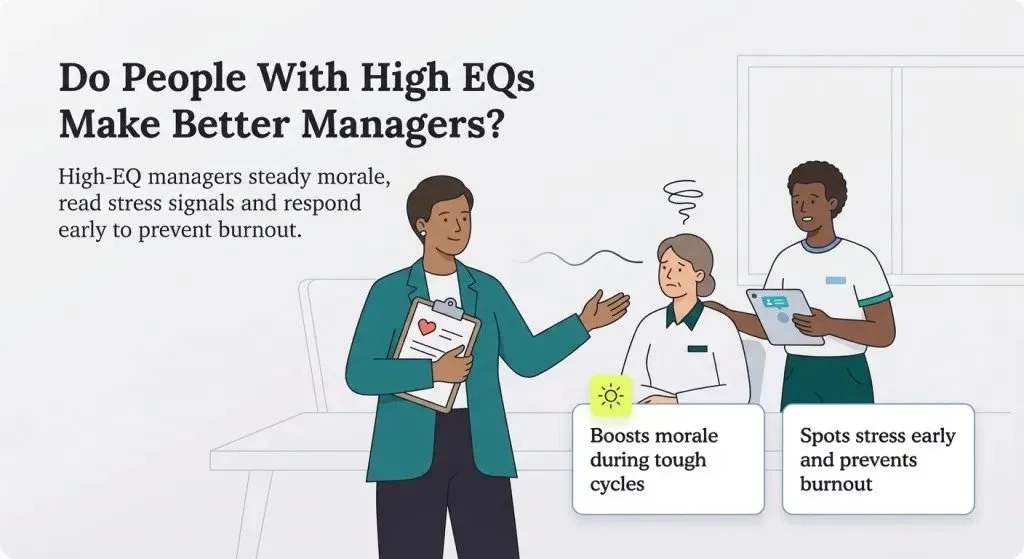
Emotionally intelligent people often make exceptional leaders, particularly when guiding teams through adversity. Sales is a mentally and emotionally demanding field — the highs of a record-breaking quarter can quickly give way to stretches where no deal seems to move forward.
An emotionally intelligent team leader can keep sales reps feeling positive during tough times by boosting the morale of the entire sales team. Their natural ability to read emotions means they’re supportive and empathetic when team members are stressed or under pressure. Additionally, they know how to help people struggling with stress, workplace burnout or other mental health issues.
A high-EQ manager can also identify their own feelings of overwhelm and seek help, take time off or otherwise proactively address the issue. This way, they can keep showing up for their team and company. A study published in Administrative Sciences even found that among managers leading teams through crisis conditions, empathy and self-regulation were the strongest predictors of employee performance — the same qualities that allow a sales manager to keep a struggling team motivated and on track.
Tip
To build a sales team that can scale as your business grows, recruit the right sales personnel for your organization, design a robust sales process and track key performance indicators to measure everyone's success.
How can you develop emotional intelligence skills?
Emotional intelligence is a highly valued skill in the business world that allows you to recognize, control and understand your emotions — and those of the people around you. While some people are naturally more emotionally attuned than others, the good news is that anyone can strengthen their EQ with intentional practice.
“Employers first need to develop their own emotional intelligence so that they can better recognize it during employment interviews,” Miyazaki said. “In addition, when conducting interviews, employers should be purposeful in assessing aspects of emotional intelligence, such as whether the job candidate actively listens, is accurately reading nonverbal cues, shows empathy for others, is self-aware and appears to show an understanding of the emotions of others.”
Here are a few easy and effective tips for becoming more emotionally intelligent:
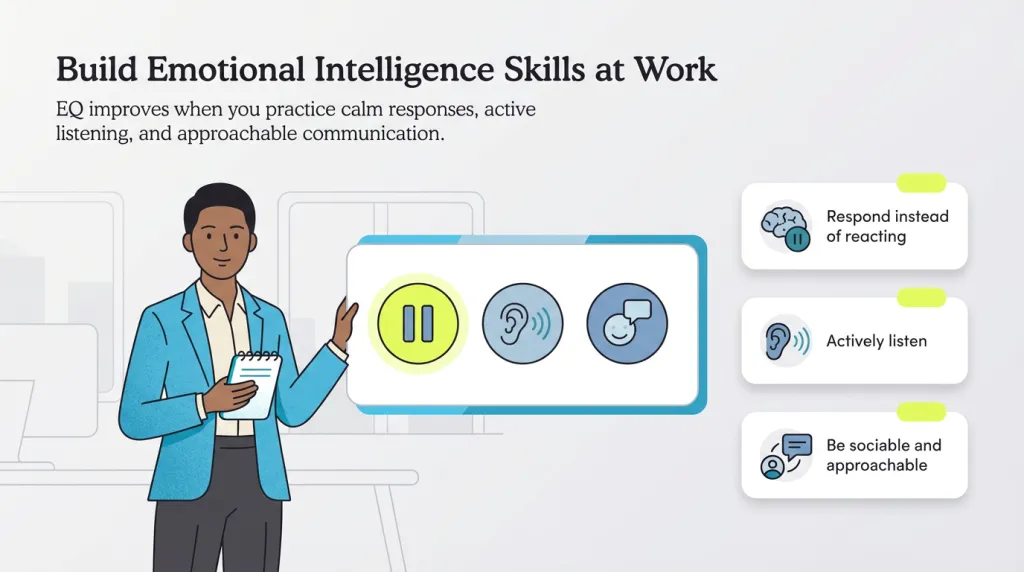
Respond instead of reacting. It’s common for feelings of anger to develop and for emotional outbursts to occur during conflict situations. Individuals with a higher EQ remain calm in stressful situations; they don’t make impulsive decisions that could lead to even bigger problems. In times of conflict, developing emotional intelligence means responding rather than reacting. Focus on making good decisions and ensure that your words and actions align with them.
Actively listen. There’s a difference between hearing and listening. An individual with a high EQ listens for clarity instead of waiting for their turn to talk. They understand what’s being said before they respond and take notice of nonverbal cues during a conversation. This helps to prevent misunderstandings, shows respect for the person talking and allows the listener to respond appropriately.
Be sociable and approachable. Smile and positively acknowledge your colleagues and customers. Radiate a positive presence and use appropriate social skills based on your relationships with the people around you. Emotionally intelligent professionals understand how to read a room, adjust their communication style accordingly, and make others feel genuinely heard and respected.
Practice self-reflection. Emotionally intelligent people make a habit of examining their own thoughts, feelings and reactions — not just in the moment, but after the fact. When a conversation goes sideways or a deal falls through, take time to ask yourself what you were feeling, how it influenced your behavior and what you might do differently next time. Journaling, mindfulness practices or simply setting aside a few quiet minutes at the end of the day can sharpen your self-awareness over time, which is the foundation on which all other EQ skills are built.
Seek and accept feedback graciously. People with high emotional intelligence actively invite honest input from colleagues, managers and even customers — and they receive it without becoming defensive. Rather than interpreting criticism as a personal attack, they treat it as useful information. If a peer tells you that you seemed dismissive in a meeting or impatient on a call, resist the urge to explain it away. Sitting with uncomfortable feedback and looking for the truth in it is one of the fastest ways to grow your emotional intelligence and strengthen your professional relationships.
Jacob Bierer-Nielsen contributed to this article. Source interviews were conducted for a previous version of this article.