

How L&D Can Strengthen Consultative Selling

By Michelle Richardson
B2B buyers don’t need salespeople to just explain product features. They can find that information on their own. What they can’t get on their own is an insightful conversation with someone who understands their business, uncovers their challenges and helps them make better decisions.
That’s why consultative selling has become one of the most important capabilities sales organizations can develop. Learning and development (L&D) professionals play a critical role in making this happen.
While sales leaders focus on revenue outcomes and coaching performance, L&D teams are responsible for creating the learning experiences that build those capabilities at scale.
A well-designed consultative sales training program doesn’t simply teach sellers what to say. It develops the thinking, behaviors and confidence required to create value in every customer conversation.
The key question to consider is whether your current learning strategy is doing enough to help sellers become the trusted advisors today’s buyers expect.
Buyer Expectations Have Changed and Training Must Too
Today’s B2B buying environment looks dramatically different than it did just a few years ago.
Buyers complete much of their research independently before speaking with a salesperson. Gartner reports that 67% of B2B buyers prefer a rep-free experience. By the time they engage with a seller, they’re looking for expertise — not another product presentation.
Buying decisions also involve larger committees, competing priorities and more scrutiny than ever before. Sellers need the ability to uncover business problems, adapt their messaging for different stakeholders and demonstrate measurable value, all of which are learned skills.
For L&D professionals, that means traditional product training and sales methodology alone aren’t enough. Modern sales curricula must intentionally develop consultative behaviors throughout the entire buyer conversation.
Common Gaps in Traditional Sales Training
Many organizations assume their top performers are naturally consultative. Research from The Brooks Group suggests otherwise.
Our analysis of over 18,000 selling skills assessments reveals a common trend: Sellers are frequently weakest in early-stage selling skills such as positioning, pre-call planning, prospecting and questioning — areas that directly influence the quality of every opportunity that follows.
However, many sales onboarding and development programs still devote a majority of instructional time to products and services, competitive positioning, customer relationship management (CRM) processes, sales presentations and pricing.
While all of these topics matter, they often receive more attention than the consultative capabilities that determine whether meaningful customer conversations happen in the first place.
High-performing sellers consistently demonstrate:
Active listening
Strategic questioning
Business-focused discovery
Value articulation
Objection management
Relationship building
These consultative skills improve through deliberate practice, feedback, reinforcement and application. For L&D teams, this means designing programs that emphasize behavioral practice rather than information transfer.
L&D professionals have an opportunity to rebalance the curriculum toward customer-centric skills that improve performance throughout the sales process.
Designing Learning That Changes Sales Behavior
Consultative selling can’t be mastered through a single workshop. Because these skills involve judgment, adaptability and communication, they require repeated opportunities to practice in realistic situations.
Effective programs often include these four pillars:
1. Skills Assessments
Assessments that identify existing competency gaps before training help focus learning objectives and allow L&D teams to tailor learning paths instead of delivering identical training to every seller.
2. Training and Scenario-Based Practice
Role-plays, simulations and buyer conversations allow sellers to practice discovery, questioning and objection handling before they face customers.
3. Reinforcement
Microlearning, spaced repetition, manager coaching guides and artificial intelligence (AI)-enabled practice keep new skills from fading after the initial event.
4. Real-World Application
Encouraging sellers to employ new techniques with active opportunities gives them a chance to apply and reflect on what works, creating a continuous learning cycle.
Measuring More Than Course Completion
L&D leaders have an opportunity to showcase business impact by focusing on more than completion rates. While completion rates tell you who attended training, they don’t show whether participants actually built the capabilities they need. Connecting learning metrics with business performance helps demonstrate the strategic value of sales training.
Meaningful metrics include:
Improvement in skills assessment results
Demonstrated proficiency during simulations
Manager observations and coaching evaluations
Adoption of consultative sales behaviors
CRM indicators tied to discovery quality or opportunity qualification
Business outcomes such as pipeline quality, win rates or sales cycle improvements (in partnership with sales leadership)
Building Consultative Discovery Skills Through the 4 Pillars
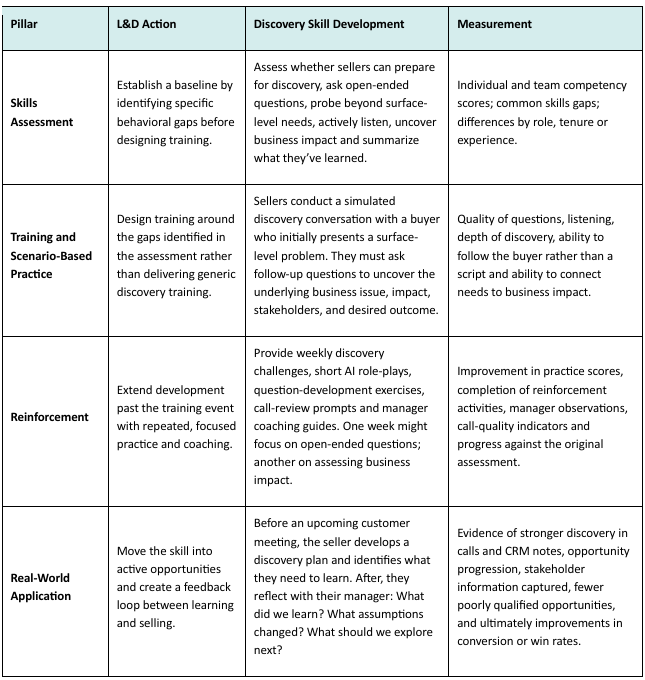
For an L&D leader, the four pillars work best as a connected development cycle rather than four separate training tactics.
First, determine what sellers can do today and train on specific skills gaps. Then, give them structured opportunities to practice and reinforce the behaviors over time. Finally, measure whether they are using those behaviors effectively with real buyers.
The chart below walks through the process, using discovery as an example skill:
Building a Learning Culture Around Consultative Selling
Consultative selling is a capability that develops over time. Therefore, the most successful organizations treat it as an ongoing learning journey supported by onboarding, reinforcement, coaching, assessments and continuous practice.
For L&D professionals, this means building learning programs that develop consultative selling as an ongoing capability rather than treating it as a one-time training event. As AI automates routine tasks and buyers continue to arrive better informed, human selling skills become even more valuable.
Today, L&D must train sellers to apply consultative behaviors in every customer interaction. Organizations that invest in developing consultative sellers are positioned to create trust, differentiate themselves and build stronger, more profitable customer relationships.