
Why You Don’t Convert More Leads to Sales

By Dave Kurlan
I’m beginning by going off topic but I will pivot back to selling and specifically, converting leads to business.
When you post on LinkedIn, should you go with a short, one-paragraph teaser, a long multi-paragraph thought piece, or a video? Or maybe even a carousel?
The answer isn’t one-size-fits-all—it’s nuanced and depends on your situation. If you run a blog or publish LinkedIn articles regularly, your approach differs from someone whose primary (or only) platform is the quick LinkedIn post.
After years of experimenting with every format imaginable, I’ve distilled it down to 8 key variables that guide the best choice for most people in sales, leadership, or professional services. Here’s what matters most in 2026:
The LinkedIn algorithm prioritizes dwell time — how long people actually spend engaging with your content. The longer they stay reading, swiping, commenting, or watching, the more the algorithm pushes your post to others. This heavily favors long-form text posts (especially 800–1,000+ words/characters with strong formatting: short paragraphs, bold key points, numbered lists, line breaks) and carousels (PDF-style multi-slide documents), which naturally boost time-on-content through swipes and saves. Saves and thoughtful comments have become even more powerful signals than likes (saves can outperform likes by 5x in distribution). Native vertical videos (30–90 seconds, with subtitles and hooks in the first 3 seconds) also perform well for quick engagement, but square or horizontal videos are getting deprioritized.
Your goal — If your main goal is driving clicks to your website or blog, the old approach was a short post with a link. In 2026, that still works but often at the cost of significantly lower initial reach. A stronger play is to deliver high value natively (via a carousel/document or well-formatted long text) so the algorithm pushes it further, then place the link in the first comment for those who want the full article. This keeps dwell time and on-platform engagement high while still capturing traffic from the most interested readers.
Longevity — Blog articles (or LinkedIn articles) can surface in Google searches, AI overviews, and evergreen discovery for years. Most LinkedIn feed posts have a short shelf life—often peaking in the first 4–24 hours, with meaningful reach fading after 48–72 hours unless engagement snowballs.
Effort required — A solid LinkedIn post can be crafted in minutes: type it, add formatting, maybe an image or emoji. Videos need scripting, filming, editing, subtitles, and thumbnails. Blogs demand titles, SEO keywords, excerpts, featured images, alt text, meta descriptions, and more. Carousels sit in the middle—create a simple PDF or Canva deck (8–12 slides max for completion rates), upload as a document, and pair with a strong caption.
Attention-grabbers — Posts with visuals outperform plain text. A strong image helps, but native vertical videos often stop the scroll hardest (especially on mobile, where most views happen). Carousels are exploding right now because each swipe signals interest and racks up dwell time—many creators report 2–3x more engagement than single images. Native documents/carousels are valued even more (they’re crushing it right now for dwell time via swipes) and the 8 variables I discuss in this article would make an outstanding carousel.
Demographics — LinkedIn’s audience skews professional: roughly 60% are 25–34, with growing Gen Z (18–24) and a solid 35+ decision-maker segment. Younger users lean toward quick videos for fast consumption, while mid-career and senior professionals still prefer readable, in-depth text for thought leadership—especially in B2B/sales contexts like sales enablement or revenue leadership.
Message and emotion — If the content needs to convey urgency, authenticity, passion, or personal storytelling (e.g., a tough sales lesson or leadership insight), video wins hands-down—it transmits tone, facial expressions, and energy that text can’t fully replicate. Purely informational or analytical messages (frameworks, data, playbooks) shine in long-form text or carousels.
Your personal strengths and consistency — The format you pick should play to what you’re naturally good at and can sustain. If you’re charismatic on camera and enjoy recording, video will feel effortless and authentic. If writing flows easily and you love structuring ideas, lean into long-form text or carousels. The biggest edge comes from posting consistently—what you actually produce regularly beats the “perfect” format you abandon after a few tries.
To put real numbers behind these ideas, here’s some eye-opening data from the people at LinkedIn on simple actions that amplify reach and engagement:
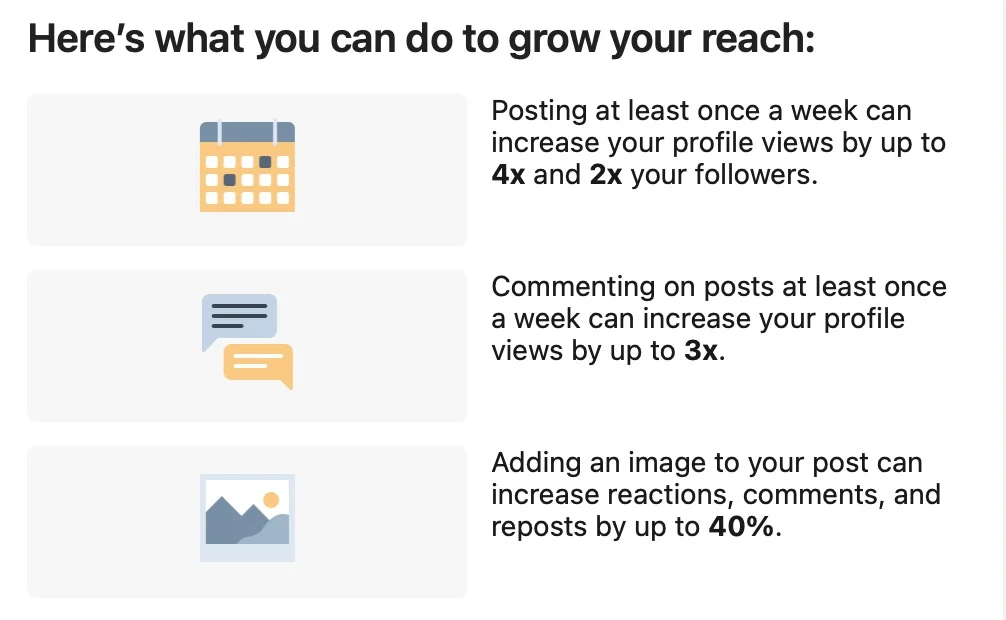
These stats highlight why blending formats strategically—and staying consistent—pays off big time, especially when the algorithm rewards dwell time and meaningful interactions over sheer volume.
So, short post, long-form text, carousel, or video?
It depends—on those variables, your audience, your goals, and especially what you can execute week after week without burning out.
For me, after testing hundreds of posts (quick hits, deep dives, rants on camera, and everything in between), here’s my current mix for sales leadership and predictable revenue content:
Short posts with links when I want to drive traffic to a fresh blog article, tool, or resource.
Long-form text (or carousels) for sparking real discussions, sharing frameworks, and positioning as a go-to voice in sales effectiveness.
Video when the message carries emotion, a personal story, or needs that human connection—it’s more work, but the relationships and comments it generates are unmatched.
The real secret isn’t locking into one format forever. It’s testing, tracking what moves the needle with your network (impressions, engagement rate, profile visits, DMs), and blending them strategically to build momentum.
Can we help you with LinkedIn or online lead gen? No, but we know a guy…
Converting Leads to Meetings and Sales
For many companies, the problem with converting leads seems like a lead generation problem, and while that might be somewhat true at some companies, the bigger problem is what the sales team does with those inbound leads.
Converting calls to meetings – The average salesperson scores only 36 in the Hunting Competency, which is only one of the 21 Sales Core Competencies. (See the scores for all 21, filter by industry, and see how your company compares at this free site.)
Companies often have young, inexperienced salespeople in BDR/SDR roles to follow up and schedule calls/meetings with sales reps and their connection/conversion rates are typically quite low. In an era where it can take 8-12 attempts to reach a prospect, especially a senior decision maker, most give up after 4-5 attempts.
Experienced sales reps typically conduct the calls/meetings on the appointments generated by BDRs/SDRs. Some of those salespeople, knowing that only 1 in 10 of the inbound leads are any good, try to quickly disqualify those leads – and succeed – “because the leads suck!” Some of them do suck, but some of them don’t.
Last week I coached a salesperson who disqualified 4 prospects with whom a BDR had scheduled meetings, and immediately said some version of, “Hi, yeah, I’m calling about our meeting and any work we do will probably cost 20% more than any other quotes you have or will get.” This is the first thing he said – before discovery, before building a case, before asking questions, before learning what’s going on, before knowing anything! Of course they’ll say, “Oh, that’s much higher than our other quotes, so no thank you.” Lazy, transactional, rushed, stupid, amateur, crazy exchange that cannot possibly convert to a sale.
Sales Managers who coach their salespeople should know this is happening. They don’t. Sales Managers who coach their salespeople should know the quick fix for solving this problem. They don’t. Sales Managers aren’t coaching their salespeople. And the relatively tiny percentage that do, do it poorly.
That’s the problem with Inbound Leads. It’s not the leads themselves, it’s the BDRs that make schedule the meetings, the salespeople who run those meetings, and the sales managers who aren’t coaching either of them to be more effective.