

Is Your HR Department a Strategic Advisor or Dysfunctional Misaligned Department?
By Michael J Griffin
For over 40 years. I have interacted with hundreds of HR departments and HR managers to deliver world class training and consulting across sales/service productivity and leadership or team development. Let’s review some of my observations and lessons learned dealing with HR and end up with two very insightful graphics by the HR Radar Blog and a past AchieveGlobal colleague of mine, Mara Marinakis.
My Observations over 40 Years Working with over 500 HR Departments
Most HR departments are not well respected by the organization board of directors or corporate leaders. Because of this, HR leaders are rarely seen as trusted business advisors to the board, shareholders or other department heads.
I have had the privilege and pleasure to collaborate with HR directors who truly were trusted business advisors to the senior leaders and their colleagues across departments and countries. Here are the “HR Stars” who demonstrated world class HR as trusted advisors to their board and shareholders: Fu Chee Cheng, Alison Shee, Adil Malia, Gautam Chakrawarthy, Anthony Joseph, Tami Coble, Patrick Donahue, Tejal Marwa, Rachita Sahgal, Suresh Sahu, and Leslie Chelvan.
HR departments are seen as “doers” of the ideas, processes and strategic initiatives other departments come up with, rather than being on the cross department teams that are the innovators or early adopters of positive change or productivity.
Very few HR leaders have a strategic, visionary mind set. Rather than seeing the “Helicopter View of the Forest” - the strategy of the shareholders/directors, HR usually is “lost among the trees” satisfied doing the admin work. Good HR departments can ride the helicopter yet harvest the trees.
Rarely do HR leaders or managers have experience as line managers, responsibility for sales or revenue, production know how, or profit center leadership. This is a big handicap for any HR department that wants to be respected as trusted business advisors to shareholders or directors. I have always suggested, hire line managers to head HR, or, give all HR managers a one to two year stint leading a profit center or a sales or service management responsibility.
The handicap mentioned in point 5 leads to another disconnect. Most HR managers are unable to communicate and talk the language that directors or profit center managers want to relate to. It is a classic case of the chickens trying to talk to the eagles. All HR managers should go through training in sales and persuasion and have a development plan to improve their EQ to be able to connect and communicate to leaders with very different business issues and communication styles than their own.
HR departments are perceived as a cost center. Rarely are they perceived has a department that can improve productivity or revenue. Therefore we have the worst sickness of HR: focus on beating down vendors on price without any concern on determining ROI or effectiveness of solutions vendors bring to their company. HR departments that are not trusted advisors only seek internal corporate recognition when they reduce cost, even if it damages their organization!
HR leaders rarely push back or offer constructive feedback to other departments to get involved in people development initiatives. HR should always involve a “project champion” from the leadership of the department most impacted by a HR, people, or process development project. A recent example we had where a new inexperienced HR manager with no sales or service experience was handed the responsibility to procure and implement sales productivity training for a US billion dollar company. This HR manager had no guidance or support from the sales director! The result is a sliding market share, high sales rep turnover, and no real ROI on sales and service training investments.
HR is often tasked with being a screen for hiring & interviewing people in departments where the HR screeners have limited or no experience. The glaring example I have seen over and over is the corporate sales department tells HR to interview for sales people when the HR interviewer has no clue what to look for in a competent or potential salesperson. This is an example of the administrator interviewing for the hunter, farmer, or key account orchestrator.
Finally, isn’t it the responsibility of the directors and shareholders to determine the quality of the people and processes in their HR department that truly is a trusted advisor, a competent team that supports and improves the revenue and productivity of their organization? Leadership for HR starts at the top…. I rest my case.
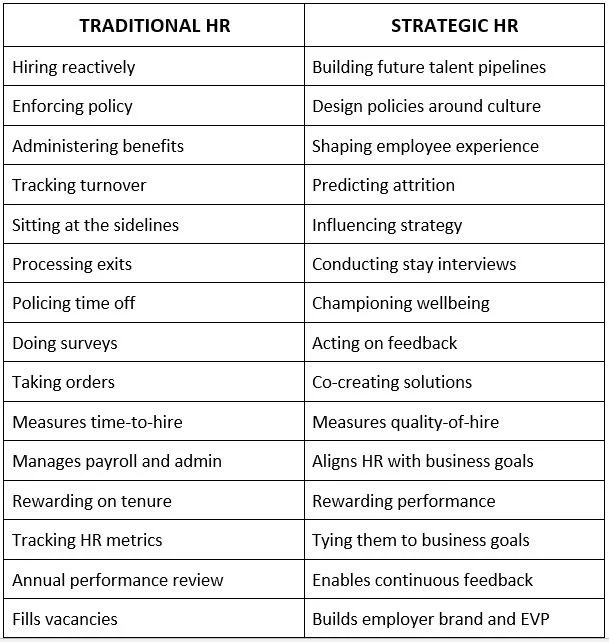
Now review the two comparison tables below and see what they might say to you about the quality or “dysfunctionality” of your corporate HR leaders and departments!
WHAT TRADITIONAL HR LOOKS LIKE VS WHAT STRATEGIC HR LOOKS LIKE
From the HR Radar Blog
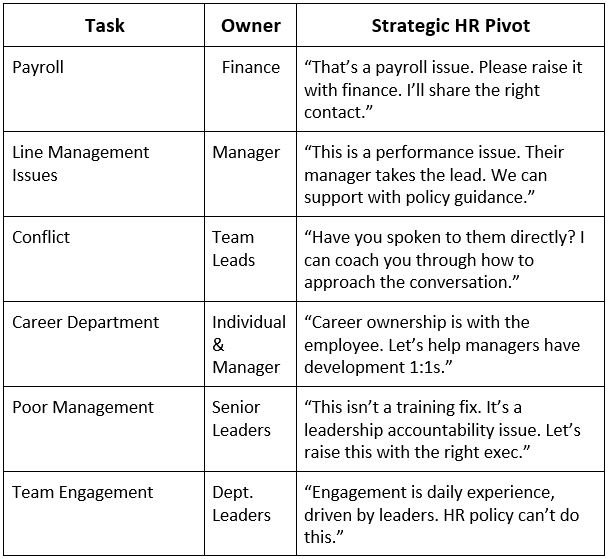
THESE ARE NOT HR TASKS!
HR Should Hand them to the correct department
By Mara Marinakis
What changes will you make in 2026 on how your HR department supports your organization success?
Michael J Griffin
Founder & APAC CEO ELAvate
Maxwell Leadership Founding Member
Committed to Supporting HR as Trusted Advisors!
michael.griffin@elavateglobal.com
+65-91194008 (WhatsApp)